
Reviewed · TEIDE NATIONAL PARK TOURS
Tenerife: Teide Stargazing with an Astrophysicist
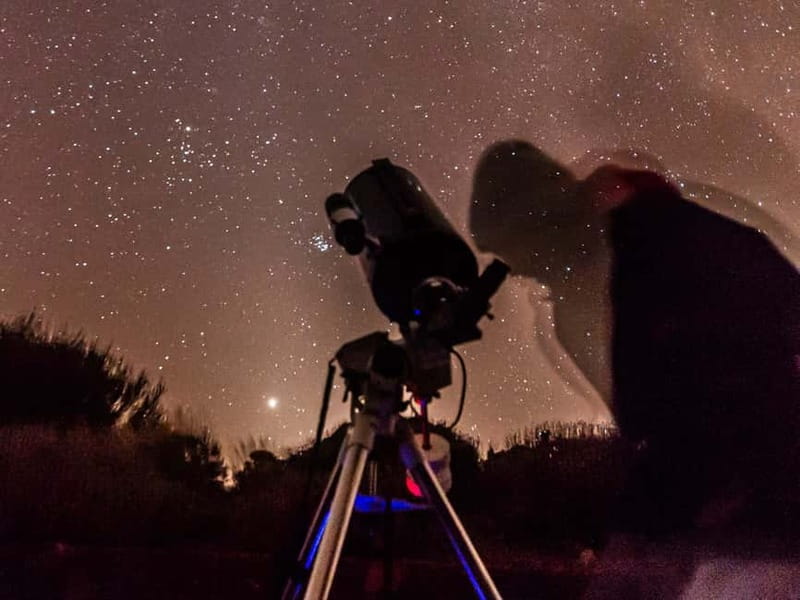
Teide National Park gives this stargazing outing a serious advantage: you are looking up from a high volcanic site far from the bright lights of Tenerife’s resorts. With astrophysicist and official guide Adal at the telescope, you may see the Moon’s craters, planets, star clusters, a nebula, or even a galaxy, depending on the night.
I like the small maximum of 10 people, which gives you room to ask questions and get a clear turn at the eyepiece. I also like the way the experience connects simple constellation stories with real astronomy and current research. The main drawback is the setting beside the Parador, where nearby light can slightly weaken the darkness. You need your own car or taxi, and mountain weather can cancel the session.
Key points at a glance
- Adal’s teaching style: He explains complex astronomy in plain language and adjusts the talk for children, beginners, and keen amateurs.
- An 8-inch telescope: The equipment is strong enough for close views of lunar craters, planets, double stars, clusters, nebulae, and other objects.
- A genuinely small group: No more than 10 participants means less waiting and more time for questions.
- Teide after dark: The high-altitude setting can reveal far more stars than you see from the coast or a resort town.
- Short, focused format: The session lasts 1.5 hours and starts and ends at the Parador de Cañadas del Teide.
- Mountain conditions matter: Bring proper warm clothing, even if Tenerife feels hot at sea level.
What the Teide stargazing experience is really like
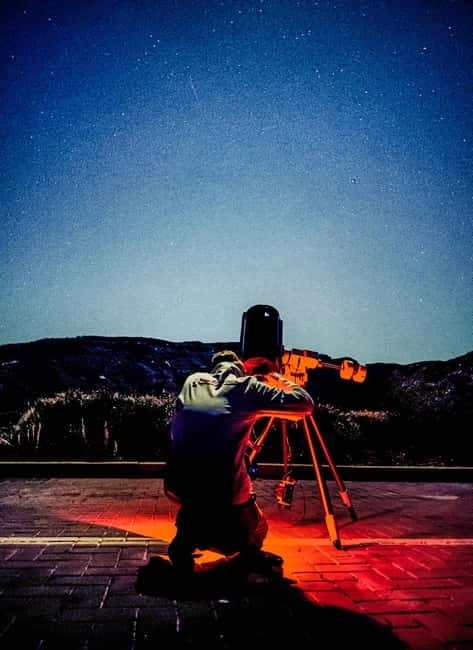
This is not a late-night drive through the park with a quick look at the sky. It is a compact astronomy lesson built around one professional telescope, a guide who knows the subject, and the changing conditions of the night.
You meet outside the entrance of the Parador de Cañadas del Teide. The hotel sits in Las Cañadas del Teide, high above the island’s main resort areas. This matters because Tenerife’s coast and tourist towns have plenty of artificial light, while the national park offers much darker skies and a clearer view of the stars.
The exact objects you see will depend on the season, the Moon, cloud cover, and what is above the horizon. On different evenings, the telescope has been used to show Jupiter, Saturn and its rings, Neptune, star families, binary stars, a reflection nebula, a galaxy, and lunar craters. You should treat the list as a sample, not a promise. Astronomy is governed by the sky, not a fixed menu.
More stargazing nights in Tenerife:
- Tenerife: Sunset and Stargazing at Teide National Park
★ 4.7 · 2,826 reviews - Teide National Park Sunset & Stargazing with Dinner (Star Safari)
★ 5.0 · 2,601 reviews - Teide by Night: Sunset & Stargazing with Telescopes Experience
★ 4.5 · 1,492 reviews
Meeting Adal beside the Parador
The meeting point is the outdoor patio at the entrance of the Parador de Cañadas del Teide. There is no included transport, so plan this part carefully. You need your own vehicle or must arrange a taxi to reach the hotel.
The experience is offered in English or Spanish, with a single-language group. That is useful if you want the explanations to move at a steady pace rather than switch between languages. Regular group sessions take place on Tuesdays and Fridays, while private sessions can be arranged on other days.
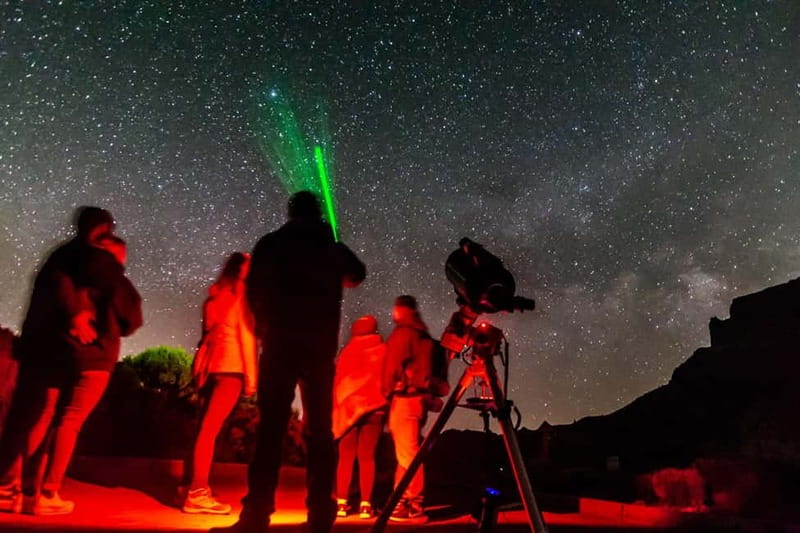
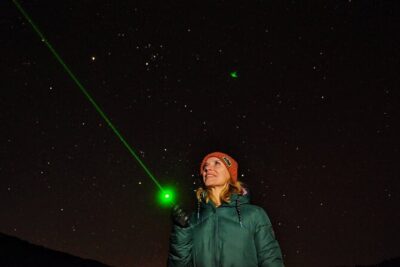
Once the group gathers, the guide introduces the equipment and the plan for the evening. The supplied lantern and laser pointer help with the practical side of the session. The laser can indicate stars and constellations without forcing everyone to crowd around a screen or printed chart.
The small group size is one of the better features here. Ten people is enough for a social atmosphere, but not so many that you spend the whole session waiting for your turn. You can ask about something you have just seen, and the guide can respond without turning the evening into a large lecture.
Learning the sky before using the telescope
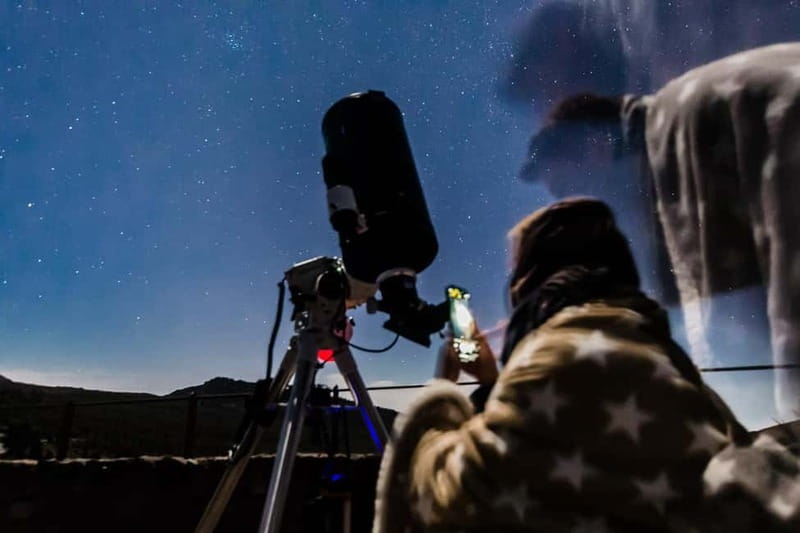
The session begins with the sky itself. Adal explains constellations, the stories attached to them, and the way astronomers use them to find their bearings. This gives beginners a useful starting point. You do not need to arrive knowing the names of stars or the difference between a nebula and a galaxy.
The mythology is part of the appeal, but the science does not get lost. The talk also covers the history of astronomy, the workings of the telescope, and ideas linked to modern astrophysical research. Adal’s approach is especially suited to mixed groups. Children can follow the stories and visual comparisons, while adults with more background can ask harder questions.
The best guides in this setting do more than recite facts. They help you understand what you are looking at. A star cluster is not just a bright patch in the eyepiece. A planet is not simply a dot. A binary star system can look like one object to the naked eye and separate into two points through the telescope.
Adal has a lively, patient way of explaining the subject. He is also willing to answer basic questions without making anyone feel out of place. That makes the outing a good choice for couples, families with older children, solo visitors, and people who have never used a telescope.
What the 8-inch telescope can show you
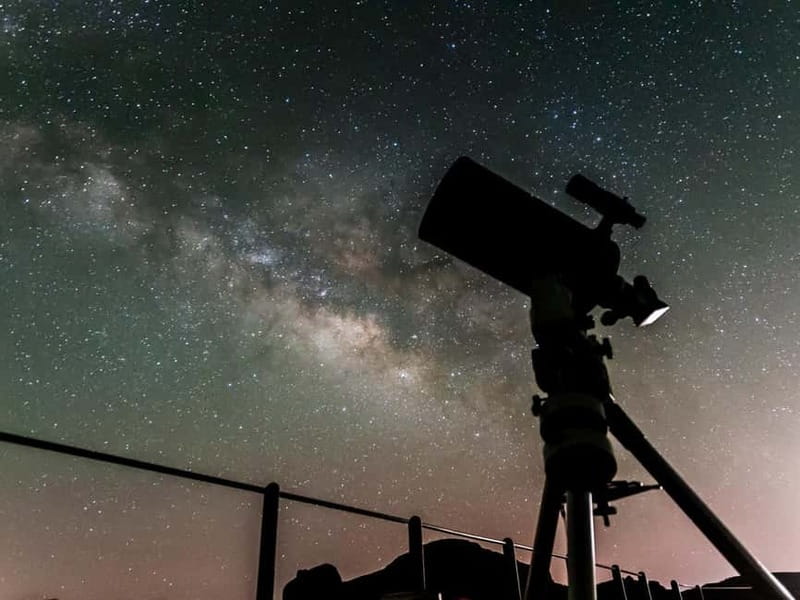
The professional 8-inch telescope is the practical heart of the experience. It is large enough to reveal detail, but still suitable for a short guided session. You will learn how the equipment is set up and how the telescope helps bring distant objects into view.
The Moon is often a particularly satisfying target. A telescope can show craters and sharp changes in light and shadow that disappear when you look at the Moon with your bare eyes. A full or nearly full Moon may be bright and impressive, though its light can make fainter stars harder to see.
Planets offer a different kind of reward. Past sessions have included Jupiter, Saturn, and Neptune. Saturn’s rings are the classic sight, while Jupiter may reveal a brighter disc and, depending on conditions, some of its moons. Neptune is much more subtle. Seeing it is less about a dramatic image and more about knowing that the small point in the eyepiece is an extremely distant planet.
Star clusters can be easier for beginners to appreciate. A group of stars that looks like a hazy patch from a distance may resolve into many separate points through the telescope. You might also see a false binary or a true pair of stars, along with a nebula or galaxy.
The telescope does not turn every object into a bright, colorful picture. This is an important expectation to set. Some objects appear as faint shapes or pale points, and the experience depends on your eyes, the sky, and the guide’s explanation. The value is in seeing real celestial objects with your own eyes, not in getting a polished image like the ones from a space agency website.
More days in Teide National Park:
- Tenerife: Mount Teide Tour with Cable Car Ticket & Transfer
★ 4.3 · 5,094 reviews - Sunset & Stargazing Experience From Teide
★ 4.5 · 1,129 reviews - Mt. Teide and Masca Valley Tour in Tenerife
★ 4.5 · 965 reviews - Tenerife: Mount Teide Summit Hiking Adventure with Cable Car
★ 4.3 · 688 reviews
Why the high mountain location helps
Teide National Park is a strong place for astronomy because you are well above the main coastal towns and their lights. The height and open surroundings can make the sky look crowded with stars compared with what you see from a hotel balcony.
Still, the best darkness is not necessarily right beside the hotel. One participant specifically wished for a spot farther from the nearby road and lights. That is a fair point. The Parador meeting place is convenient and easy to identify, but it is not the same as standing in a completely unlit field.
Think of the location as a practical compromise. You get a known meeting point, a proper telescope, and a qualified guide without an all-night expedition into an isolated part of the park. If your top priority is the darkest possible sky, ask about the exact observing position when booking a private session. For most visitors, the combination of high altitude and expert guidance will matter more than chasing a few extra degrees of darkness.
The setting also affects temperature. At sea level, Tenerife may feel mild or warm. At the Parador, conditions can be much colder, especially after sunset. From October through March, prepare for temperatures around 0 to 4 degrees Celsius. From April through September, expect roughly 10 to 15 degrees Celsius. Wear layers, warm shoes, and thermal clothing when needed.
A 1.5-hour itinerary with no wasted travel time
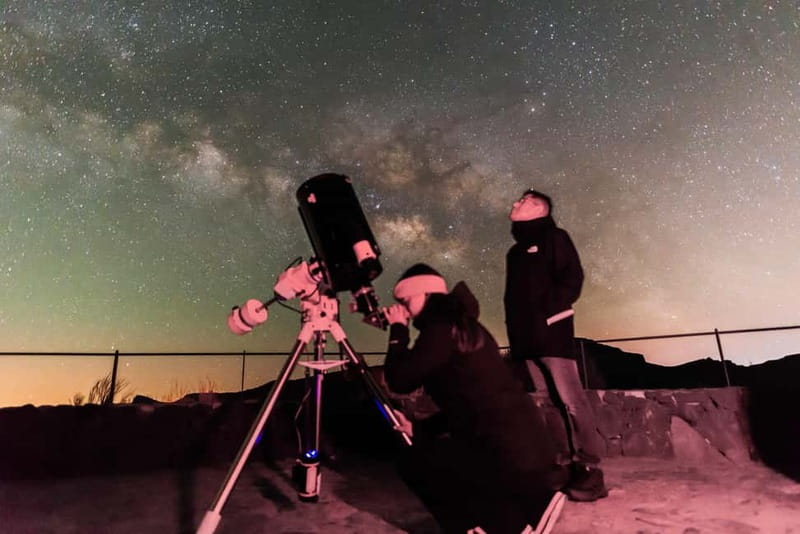
The scheduled activity lasts 1.5 hours, and the route is simple. You meet at the Parador, take part in the guided astronomy session, and return to the same location at the end.
That short format works well if you are building a larger Tenerife itinerary. You do not lose an entire evening to a long transfer or a full-night excursion. It also keeps the subject focused. You have enough time for an introduction, constellation explanations, equipment guidance, and several telescope observations without the session becoming tiring.
The limit is that 90 minutes can pass quickly. If the sky is cloudy, if several objects require careful setup, or if the group has many questions, you may not see every kind of object listed in the general description. A private session on another day may suit you better if you want a slower pace or have a special astronomy interest.
Bring water and wear comfortable clothes and shoes. The activity does not include food or drinks, so eat beforehand and do not expect refreshments at the observing point. The instruction to bring your own vehicle is not a minor detail. The hotel is in a mountain park, and you should not book this outing until you have a reliable plan for reaching it and returning afterward.
The guide makes the difference
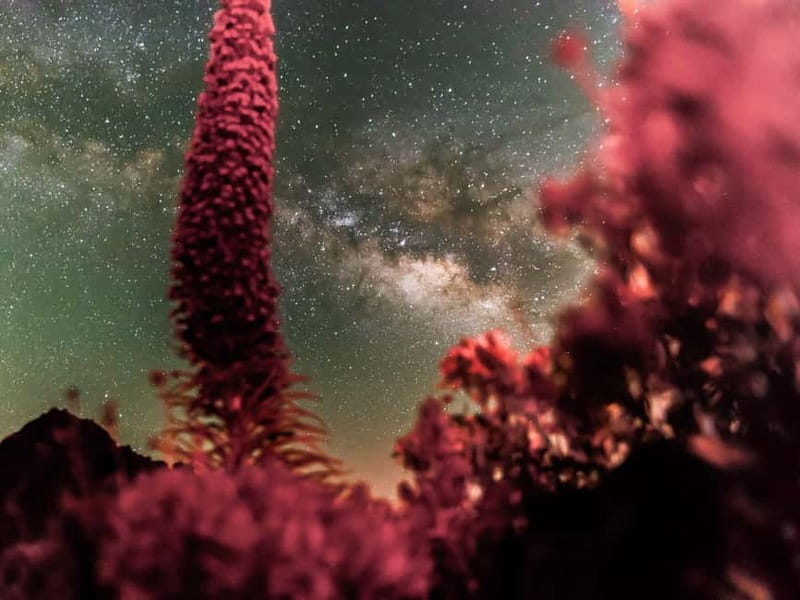
The strongest part of this experience is the guide’s ability to make astronomy feel approachable. Adal has led sessions that included children aged nine and thirteen, as well as adults with little previous knowledge. He explains the telescope, pauses to check that people understand, and changes the focus according to the conditions that night.
That flexibility matters. A rigid script would not work well under a changing sky. If clouds cover one target, the session can shift to another part of the sky. If the Moon is especially clear, it may become the main event. If the planets are well placed, they may take priority.
Adal also brings humor and enthusiasm to the science. You can expect stories, questions, and explanations rather than a silent queue at the telescope. The guide’s passion is useful because it encourages you to keep looking after the session ends. A good stargazing tour should give you a few facts, but it should also teach you how to pay attention to the sky.
The guide is listed as an astrophysicist and certified official guide. That combination gives the tour more substance than a basic constellation talk. You are not just learning star names. You are getting a window into how astronomers study the universe and how the equipment helps them do it.
Is $47 a fair price?
At $47 per person, this is a reasonable price for a 1.5-hour small-group session led by a trained astrophysicist and official guide. The value comes from the equipment, the specialist instruction, and the limited group size rather than from the length of the activity.
You are not paying for transport, dinner, or a full evening of entertainment. Those costs remain yours. But you also avoid paying for a package filled with services you may not want. If you already have a rental car and plan to visit Teide, this can be an efficient way to add a focused astronomy experience.
The price is easier to justify for anyone who would otherwise try to identify objects alone. Buying or carrying suitable equipment is not practical for most holidaymakers, and a guide can point the telescope at objects you might never find by yourself.
The value is less certain if you expect a long remote stargazing expedition, a meal, or a guarantee of clear skies. You are paying for access to a guided observation session, not a promise that every planet or nebula will appear. Weather can cancel the activity, in which case the provider offers a full refund. If you cancel yourself, the stated deadline is 24 hours before the start time.
Who should book this experience?
I would recommend it to beginners who want a clear introduction to the night sky, couples looking for an unusual evening, and families with children old enough to handle the cold and late setting. It also suits amateur astronomy fans who want a local guide to point out objects from Tenerife.
The small group is helpful for solo visitors. You will have people around you, but the session should not feel like a crowd. English and Spanish are available, so choose the language that lets you ask the best questions.
The activity is not suitable for babies or children under eight. The high mountain cold and evening conditions can be hard for younger children, and the guidance notes suggest that it may not suit some children under about seven to nine. Use your judgment based on the child’s patience, clothing, and comfort in cold conditions.
You should also skip it if you dislike fixed outdoor plans in uncertain weather. The activity may be canceled on the day if conditions at the mountain are unsafe. That can be disappointing after you have driven up, but it is the sensible decision for a night activity at high altitude.
Should you book the Teide astrophysicist stargazing tour?
Book it if you want a compact, well-explained introduction to astronomy, have transport to the Parador, and are willing to dress for mountain weather. The combination of Adal’s teaching, a maximum group size of 10, and a proper 8-inch telescope gives the experience more depth than a casual look at the stars from a hotel terrace.
I would be especially keen to book it on a clear night when the Moon, planets, or a notable constellation are visible. Just keep your expectations realistic: the exact objects cannot be guaranteed, nearby light may remain visible, and clouds can cancel the session. With those limits in mind, this is a strong-value evening for curious beginners and anyone who wants to see Tenerife’s sky with a guide who can explain what is really up there.
FAQ
Where does the stargazing experience start?
It starts at the entrance and outdoor patio of the Parador de Cañadas del Teide Hotel in Las Cañadas del Teide, Santa Cruz de Tenerife.
How long does the activity last?
The guided stargazing session lasts 1.5 hours.
What languages are available?
The live guide is available in English and Spanish. Groups are organized as single-language sessions.
How many people are in the group?
The group is limited to a maximum of 10 participants.
Is transportation included?
No. You need your own vehicle or must arrange a taxi to reach the meeting point.
What equipment is provided?
The experience includes an 8-inch telescope, a laser-guided experience, and a lantern.
What should I wear?
Bring warm, weather-appropriate clothing, comfortable shoes, warm shoes, and thermal clothing when needed. From October through March, temperatures may be around 0 to 4 degrees Celsius. From April through September, they may be around 10 to 15 degrees Celsius.
Can the activity be canceled because of weather?
Yes. High mountain weather can cause cancellation. If the provider cancels, you receive a full refund.
Just added around Tenerife
- 3h Whale Watching Private tour Beneteau Oceanis 440★ 5.0 · 3 reviews
- Tenerife: Photography Sessions – Families, Couples, Friends★ 5.0 · 26 reviews
- Quad tour (option : Teide morning or Sunset tour)★ 4.5 · 26 reviews
- Beginner Scuba Dive with Scubapoint Tenerife in Turtle Area★ 4.7 · 8 reviews
- Tenerife: 2 Diving Sessions for Certified Divers★ 4.2 · 7 reviews
- small group surf lesson in Playa de las Américas,Tenerife★ 5.0 · 31 reviews
- sunset stand up paddle★ 5.0 · 29 reviews
- Yoga at the beach in Tenerife★ 5.0 · 21 reviews
Teide National Park Tours, compared.
Mount Teide Tour with Cable Car Ticket & Transfer
Read our review →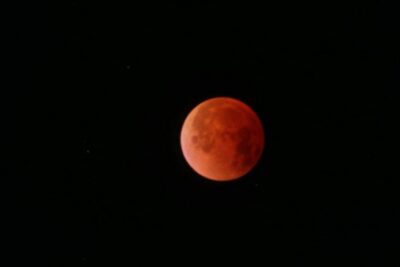
Teide National Park Sunset & Stargazing with Dinner (Star Safari)
Read our review →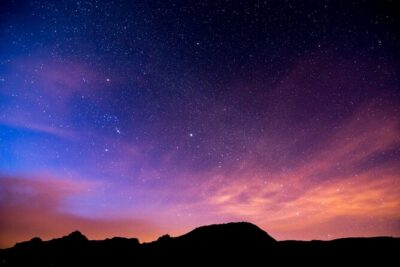
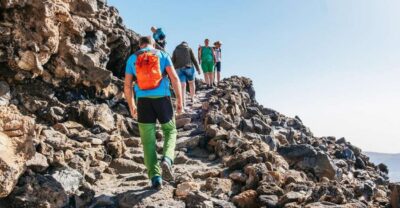
Mount Teide Summit Hiking Adventure with Cable Car
Read our review →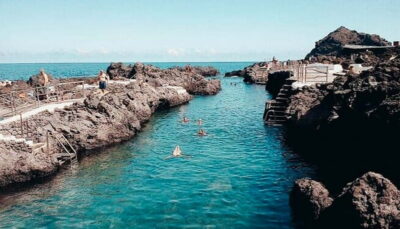
Teide, Icod de los Vinos & Garachico Full Day Tour
Read our review →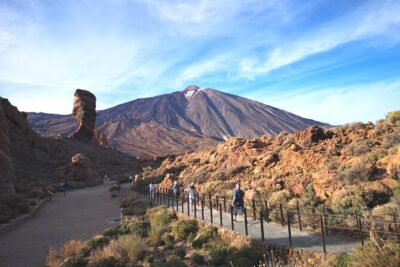
Small Group Teide National Park Volcanic and Forest Wonders
Read our review →Browse the lists this tour appears in